Norway

The 5th battalion, from the north of the county, had been transferred to the Royal Engineers when it was converted into a searchlight unit in 1937.  There was a recruitment drive in March 1939 when the government doubled the size of the Territorial Army and Lincolnshire was the first county to report that the target had been reached.  There were now so many men in the 4th battalion that another battalion--the 6th--had to be formed.  With headquarters at Grantham, this comprised the men from the south of the county.  The 4th battalion was left with the companies at Horncastle ("B" Company), Boston ("C"), Alford and Spilsby ("D") and Lincoln ("HQ" and "A"). 

Click on the links below to read the full story

Home

Norway

Iceland

Normandy

Belgium

Holland

Germany

Links

The Book

The Territorial Army was mobilised on 1st September 1939, the day Hitler invaded Poland.  The men left  work, changed into their uniforms, said goodbye to their families, reported to their depots and went off to war.

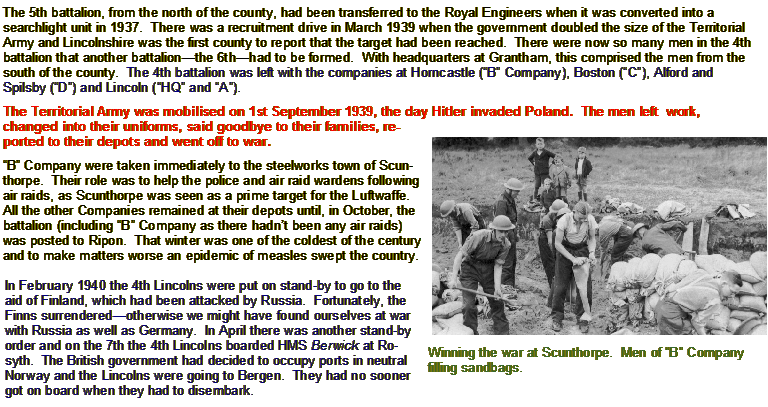
"B" Company were taken immediately to the steelworks town of Scunthorpe.  Their role was to help the police and air raid wardens following air raids, as Scunthorpe was seen as a prime target for the Luftwaffe.  All the other Companies remained at their depots until, in October, the battalion (including "B" Company as there hadn't been any air raids) was posted to Ripon.  That winter was one of the coldest of the century and to make matters worse an epidemic of measles swept the country. 

In February 1940 the 4th Lincolns were put on stand-by to go to the aid of Finland, which had been attacked by Russia.  Fortunately, the Finns surrendered--otherwise we might have found ourselves at war with Russia as well as Germany.  In April there was another stand-by order and on the 7th the 4th Lincolns boarded HMS Berwick at Rosyth.  The British government had decided to occupy ports in neutral Norway and the Lincolns were going to Bergen.  They had no sooner got on board when they had to disembark.  Hitler had forestalled the British plans.  His invasion of Norway was taking place, and HMS Berwick was ordered to join the rest of the Fleet.  Five days later, the Lincolns boarded the Empress of Australia, a requisitioned liner.  With the other two Territorial Army regiments in the 146th Brigade--the 4th King's Own Yorkshire Light Infantry (KOYLI) and the Hallamshire (City of Sheffield) battalion of the York and Lancaster Regiment--they set sail for Narvik in northern Norway. 

Winning the war at Scunthorpe.  Men of "B" Company filling sandbags.

During the voyage, the Empress of Australia and other ships with 146 Brigade on board were ordered to leave the convoy and sail for the small port of Namsos, about 50 miles north of Trondheim.  Whitehall had decided to mount a full-scale head-on assault at Trondheim and 146 Brigade was to be part of a pincers movement.  The men aboard the Empress of Australia and the other ships--including the escorting destroyers--were bombed by German aircraft.  Nevertheless the troops landed at Namsos--which had also been bombed.  Meanwhile, Whitehall had now gone off the idea of the head-on assault.  This was the first major operation of the war and everyone was anxious not to make a mistake. The Admiralty was worried about losing warships from air attack, the RAF couldn't provide either the navy or the army with air cover unless an airfield was captured and the Army couldn't capture an airfield unless the Navy could land them and the RAF could provide air cover. Out of this confusion came the decision to cancel the frontal attack on Trondheim. It would now be captured by Territorials-- from Namsos in the north and Andalsnes (148 Brigade) in the south.  Incredibly, no-one thought of telling General Carton de Wiart VC, commanding the Allied Forces at Namsos, of the change of plan.

The Lincolns moved by train to Steinkjer, a small port on the ice-bound Trondheim fjord.  From there, "D" Company was sent a few miles south to Vist.  Two days later, a Sunday, the British were amazed to see German boats landing troops at a number of points along the supposedly frozen fjord. The navy, still worried about air attack, were unable to intervene and the whole right flank of the British land forces was now very vulnerable from the sea.  The enemy soldiers were in fact Austrian mountain troops, and with skis and snowshoes they could move over the snow-bound countryside, whereas the British troops were confined to the roads.  "B" Company was hurriedly sent in lorries and buses to support "D" Company at Vist. 

There were no maps.  "B" Company walked along a track to the right of "D" Company, the snow piled five feet high on either side.  The enemy troops were thought to be at least five miles away, so it came as a shock when shots rang out and the two leading men fell, bleeding in the snow.  A German reconnaissance plane flew overhead. "B" Company found cover in a nearby farmhouse until some tracer bullets set it--and the outbuildings--alight.  Under cover of the smoke they staggered through the deep snow and reached safety.     

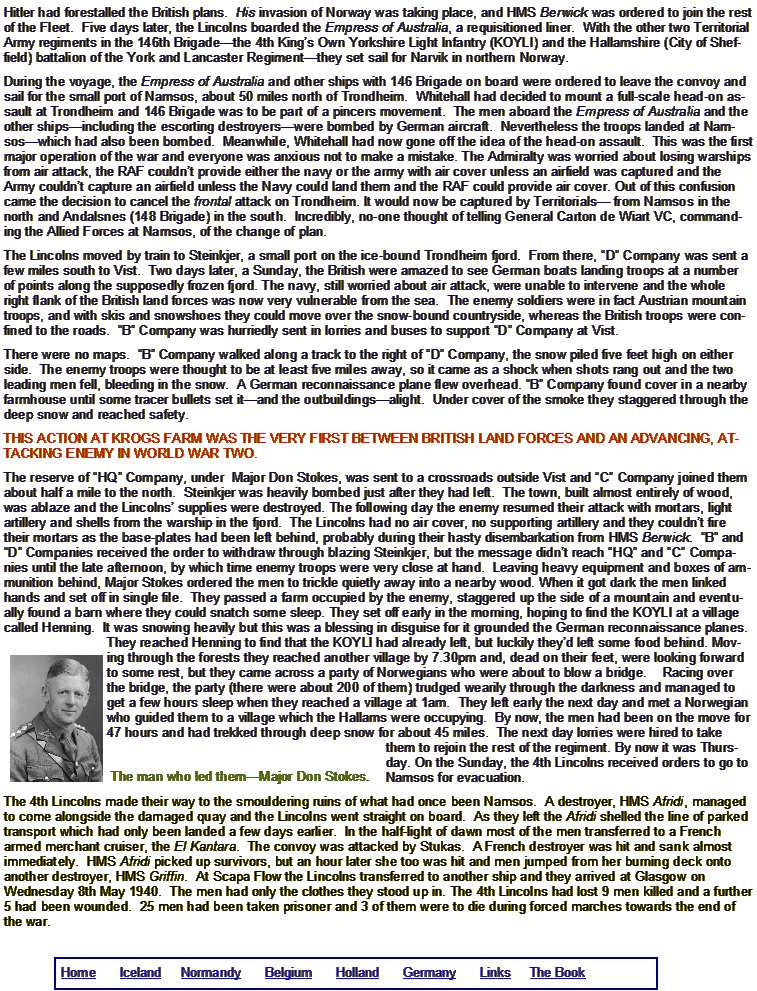
The reserve of "HQ" Company, under  Major Don Stokes, was sent to a crossroads outside Vist and "C" Company joined them about half a mile to the north.  Steinkjer was heavily bombed just after they had left.  The town, built almost entirely of wood, was ablaze and the Lincolns' supplies were destroyed. The following day the enemy resumed their attack with mortars, light artillery and shells from the warship in the fjord.  The Lincolns had no air cover, no supporting artillery and they couldn't fire their mortars as the base-plates had been left behind, probably during their hasty disembarkation from HMS Berwick.  "B" and "D" Companies received the order to withdraw through blazing Steinkjer, but the message didn't reach "HQ" and "C" Companies until the late afternoon, by which time enemy troops were very close at hand.  Leaving heavy equipment and boxes of ammunition behind, Major Stokes ordered the men to trickle quietly away into a nearby wood. When it got dark the men linked hands and set off in single file.  They passed a farm occupied by the enemy, staggered up the side of a mountain and eventually found a barn where they could snatch some sleep. They set off early in the morning, hoping to find the KOYLI at a village called Henning.  It was snowing heavily but this was a blessing in disguise for it grounded the German reconnaissance planes. They reached Henning to find that the KOYLI had already left, but luckily they'd left some food behind. Moving through the forests they reached another village by 7.30pm and, dead on their feet, were looking forward to some rest, but they came across a party of Norwegians who were about to blow a bridge.           

The man who led them--Major Don Stokes.