Iceland

The 4th Lincolns made their way to the smouldering ruins of what had once been Namsos.  A destroyer, HMS Afridi, managed to come alongside the damaged quay and the Lincolns went straight on board.  As they left the Afridi shelled the line of parked transport which had only been landed a few days earlier.  In the half-light of dawn most of the men transferred to a French armed merchant cruiser, the El Kantara.  The convoy--two transport ships, two cruisers and four destroyers--was attacked by Stukas.  A French destroyer was hit and sank almost immediately.  HMS Afridi picked up survivors, but an hour later she too was hit and men jumped from her burning deck onto another destroyer, HMS Griffin.  At Scapa Flow the Lincolns transferred to another ship and they arrived at Glasgow on Wednesday 8th May 1940.  The men had only the clothes they stood up in. The 4th Lincolns had lost 5 men killed and a further 5 had been wounded. 25 men had been taken prisoner, and 3 of them were to die during forced marches towards the end of the war.

Considering the odds against them, the Lincolns could count themselves lucky that their losses hadn't been greater. Half-trained young Territorials with inadequate and insufficient weapons--little more than regiments on paper--had been sent to Norway.  There had been no air cover and no artillery.

All leave was stopped when the Germans invaded Holland, Belgium and France two days after the 4th Lincolns had arrived in Scotland, but despite this a special train took the men to Lincolnshire for 10 days leave. They reported back to a camp near Hawick, Scotland where they were re-equipped.  On Monday 23rd June 1940 the 4th Lincolns set sail again, this time to neutral Iceland which British forces had occupied a few weeks earlier.

Click on the links below to read the full story

Home

Norway

Iceland

Normandy

Belgium

Holland

Germany

Links

The Book

The Lincolns were sent to Akureyri, on the north coast.  Although it was the second largest town in Iceland, the population was 6,000--about the size of Horncastle.  The Icelandic people were cold and aloof at first, but the British brought work and trade and gradually the relationship became warm and friendly.  Almost all the population lived on the coast of this barren, volcanic island.  There were hardly any trees, no vegetables were grown and almost everything had to be imported. At first, the Lincolns were under canvas but Nissen huts arrived before the onset of the gloomy winter, when it didn't get light until 10 o'clock and began to get dark again at 3pm.

Some of the men were sent to set up observation posts.  Corporal Tony Bell from Horncastle was sent with five men to a tiny community with only four houses on the north-eastern tip of Iceland. The only way of getting there was by boat. They were given 70 days rations and were rowed ashore. The hearts of the men sank as they watched the coaster disappear over the horizon. The inhabitants came out and stared at them curiously.  Eventually one of them who could speak a little English agreed that they could use a small wooden hut.  The men had to construct some bunks from scrap pieces of wood and cooking had to be done outside on an open fire until they made a stone fireplace with an oven made from some old biscuit tins. Tony's men had to keep a diary with details of all they had seen, but what they would have done had the Germans arrived is anyone's guess as there was no communication with their base.

     The Lincolns' camp at Akureyri.

Open-air swimming pool.  The water was heated by natural volcanic geysers.

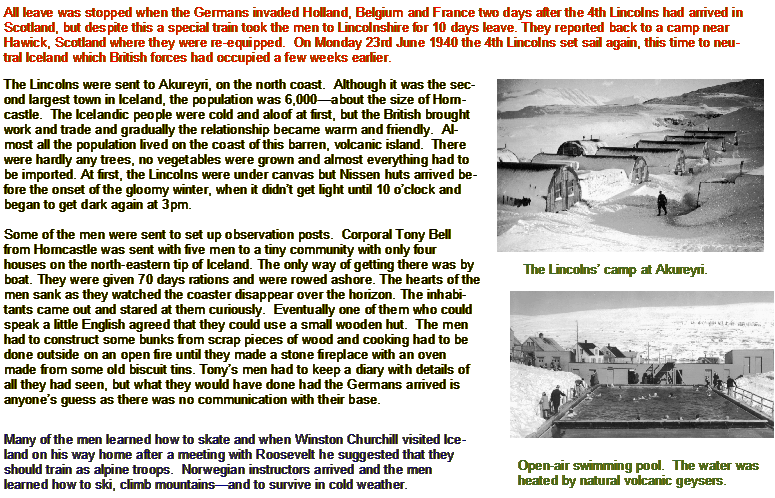
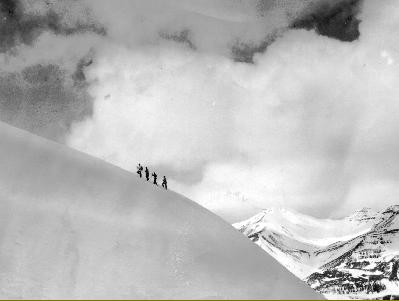
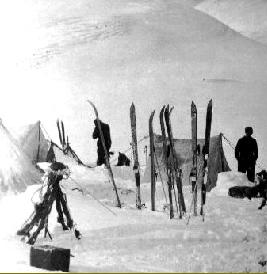
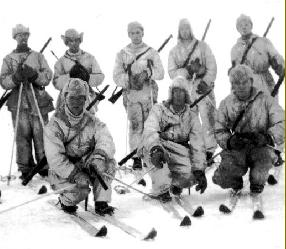
Many of the men learned how to skate and when Winston Churchill visited Iceland on his way home after a meeting with Roosevelt he suggested that they should train as alpine troops.  Norwegian instructors arrived and the men learned how to ski, climb mountains--and to survive in cold weather. 

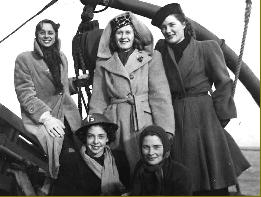
These charming girls from ENSA braved the dangers and the rough seas of the North Atlantic to entertain the troops at Akureyri.

Training as alpine troops.

Eventually, troops from neutral America arrived to occupy neutral Iceland.  After more than two years, the 4th Lincolns finally returned to England in September, 1942.