Holland

Towards the end of October a very successful experiment was carried out.  Two Canadian Armoured Regiments and a Belgian detachment were placed under the command of the 4th Lincolns' CO, Lt-Col Barclay and together with the regiment they became known as "Impforce".  "A", "B" and "C" Companies went with the 6th Canadian Armoured Regiment under their CO, Lt-Col White and were known as "Whiteforce", whilst "D" Company was placed in "Gorforce" with the 27th Canadian Armoured Regiment and their CO Lt-Col Gordon.

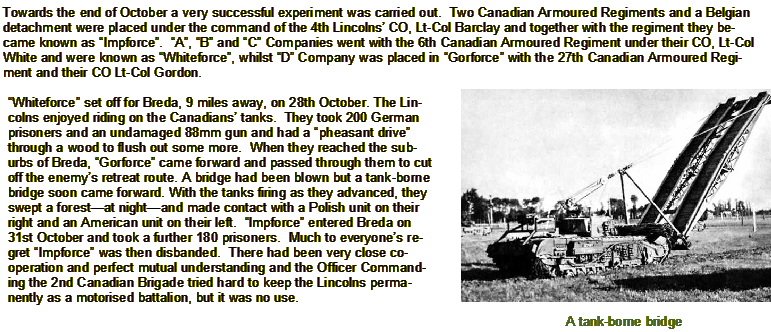
"Whiteforce" set off for Breda, 9 miles away, on 28th October. The Lincolns enjoyed riding on the Canadians' tanks.  They took 200 German prisoners and an undamaged 88mm gun and had a "pheasant drive" through a wood to flush out some more.  When they reached the suburbs of Breda, "Gorforce" came forward and passed through them to cut off the enemy's retreat route. A bridge had been blown but a tank-borne bridge soon came forward. With the tanks firing as they advanced, they swept a forest--at night--and made contact with a Polish unit on their right and an American unit on their left.  "Impforce" entered Breda on 31st October and took a further 180 prisoners.  Much to everyone's regret "Impforce" was then disbanded.  There had been very close co-operation and perfect mutual understanding and the Officer Commanding the 2nd Canadian Brigade tried hard to keep the Lincolns permanently as a motorised battalion, but it was no use.     

Click on the links below to read the full story

Home

Norway

Iceland

Normandy

Belgium

Holland

Germany

Links

The Book

After a few days rest the 4th Lincolns moved to Willemstad on the southern bank of the River Maas estuary. Patrols reported that all the ways into the town were covered by enemy fire.  A small party was sent forward under a white flag demanding surrender, or failing that to ask for the several thousand Dutch inhabitants to be evacuated before the battle.  The German commander refused to surrender but he agreed to arrange for the Dutch to leave.  A pathetic procession of Dutch men, women and children with their few possessions trudged through the Lincolns' lines. 

After an artillery bombardment "A" and "D" Companies advanced into Willemstad early the next day--to find no-one there!  All the Germans had slipped away during the evacuation of the Dutch civilians and had crossed to the other side of the estuary.

A tank-borne bridge

In mid-November the whole 49th Polar Bear Division travelled a long way east.  The Lincolns were near Venlo, a town which was only a few miles from the German border.  On the 20th the Lincolns advanced towards Maasbree with a squadron of tanks from the 44th Royal Tank Regiment.  It was raining heavily and one by one the tanks became bogged down in the mud, so there was a shortage of fire-power, but there was cover from the 25-pounders of the Royal Artillery as "B" Company managed to reach their objective--a triangular-shaped wood. "C" Company then pushed through to some heavily-defended crossroads and managed to beat off a counter-attack once they had established themselves there.  During the night several patrols went out and discovered valuable information about the Germans' positions. It was decided to mount the attack  to capture Maasbree under cover of darkness the following night.   

"A" and "D" Companies moved off in the dark, the silence broken by clatters and curses as the men tripped over things like telegraph wires which had come down. By 8 o'clock in the morning Maasbree had been completely occupied.The whole thing had gone like clockwork.  After five months in the NW Europe campaign all the cogs were well-oiled and the 4th Lincolns were now a highly-competent and experienced battalion.  Much of the credit was due to the leadership of their 35-year old CO, Lt-Col Barclay.  Although the Lincolns were now only a mile or two from Germany they weren't given the opportunity of being amongst the first troops to set foot on German soil, for they were moved again, this time to Nijmegen.

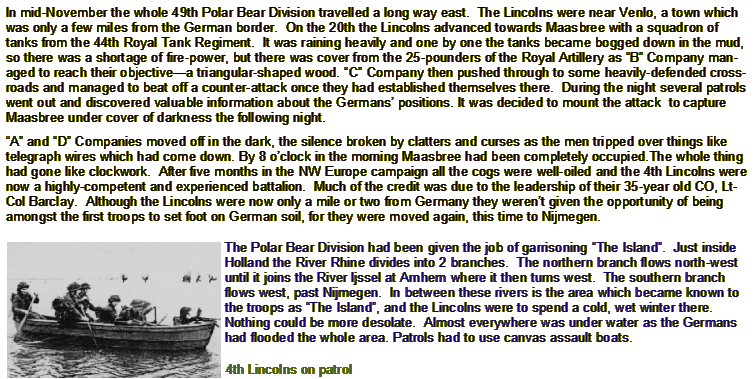
The Polar Bear Division had been given the job of garrisoning "The Island".  Just inside Holland the River Rhine divides into 2 branches.  The northern branch flows north-west until it joins the River Ijssel at Arnhem where it then turns west.  The southern branch flows west, past Nijmegen.  In between these rivers is the area which became known to the troops as "The Island", and the Lincolns were to spend a cold, wet winter there.  Nothing could be more desolate.  Almost everywhere was under water as the Germans had flooded the whole area. Patrols had to use canvas assault boats.

For 4 months, the Lincolns were literally in a backwater.  Bogged-down on the Island, life was a boring, wet, cold and thoroughly miserable routine of patrols, sniping and the odd small engagement with the enemy here and there.

With the rest of the Division, the Lincolns at last advanced from the Island in early April 1945.

         4th Lincolns on patrol

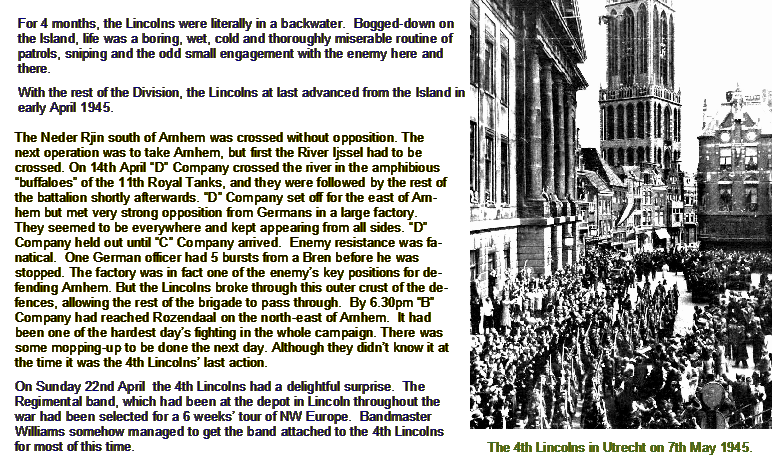
The 4th Lincolns in Utrecht on 7th May 1945.